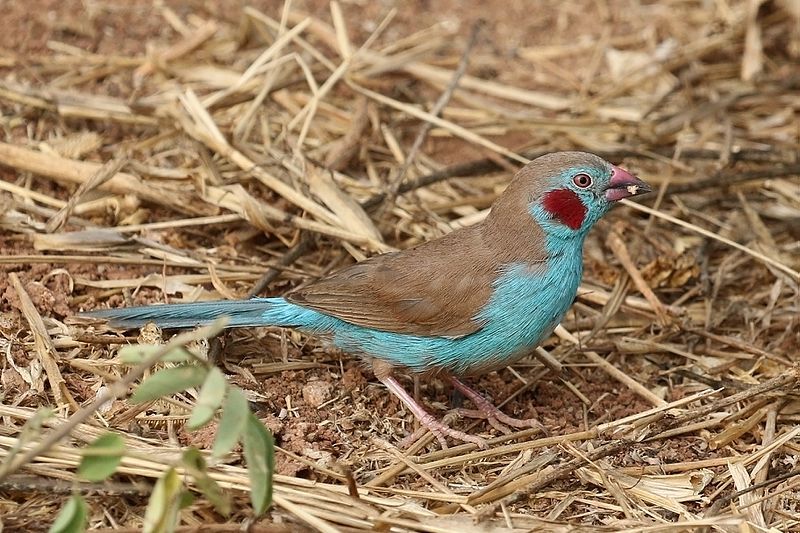
The red-cheeked cordon-bleu is a small passerine bird. This estrildid finch is a resident breeding bird in drier regions of tropical Sub-Saharan Africa. Like other members of its genus, the red-cheeked cordon-bleu is a very
small finch, measuring only 12.5–13 cm in length.It is frequently seen at open dry grassland and savanna habitats as well as around human habitation. The red-cheeked cordon-bleu is a granivore, feeding principally on grass seeds, but also on millet and other small seeds. It is also known to feed sporadically on beeswax.The nest is a large domed grass structure with a side entrance in a tree, bush or thatch into which 4–5 white eggs are laid.
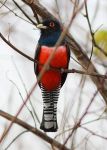
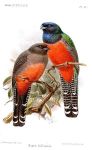
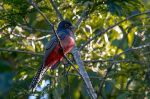
The blue-crowned trogon is a species of bird in the family Trogonidae. It is found in Argentina, Bolivia, Brazil, Colombia, Ecuador, Paraguay, and Peru. Its natural habitats are subtropical or tropical moist lowland forests and heavily degraded former forest.The male has a blue crown, a black face, a red belly, a green back and a striped tail. The female lacks the colourful plumage.
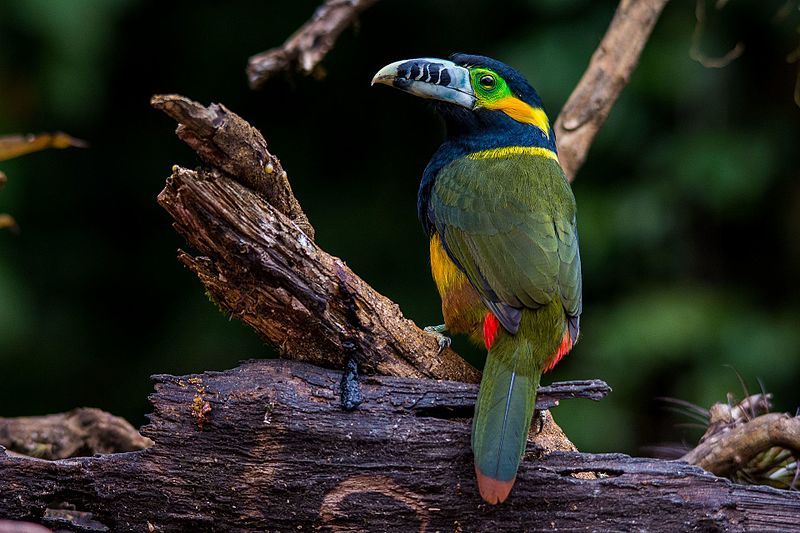
The spot-billed toucanet is a species of bird in the toucan family Ramphastidae. It is found in the Atlantic Forest of south-eastern Brazil, far eastern Paraguay, and far north-eastern Argentina (Misiones).
Most of our perception of what Goblin sharks looks like comes from dead specimines where they are all mangled and shrivelled, and are always positioned with their jaws protruding out.
When while alive they only ever extend their jaw for feeding, and arnt half as creepy looking
they do look like goblins
this also disregards the fact that they can still propel their jaws forward like an aquatic xenomorph from hell
So can many other fish, I’m just not judging them for their beautiful smile.
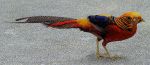
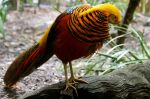
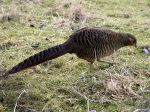
The golden pheasant is a gamebird of the order Galliformes (gallinaceous birds) and the family Phasianidae (pheasants). It is native to forests in mountainous areas of western China, but feral populations have been established in the United Kingdom, Canada, the United States, Mexico, Colombia, Peru, Bolivia, Chile, Argentina, Uruguay, the Falkland Islands, Germany, Belgium, the Netherlands, France, Ireland, Australia and New Zealand. The adult male is 90–105 cm in length, its tail accounting for two-thirds of the total length. The female (hen) is much less showy, with a duller mottled brown plumage similar to that of the female common pheasant.They feed on the ground on grain, leaves and invertebrates,
but they roost in trees at night. While they can fly clumsily in short
bursts, they prefer to run and spend most of their time on the ground.
If startled, they can suddenly burst upwards at great speed and with a
distinctive wing sound.













 kluskiwszechmocy



