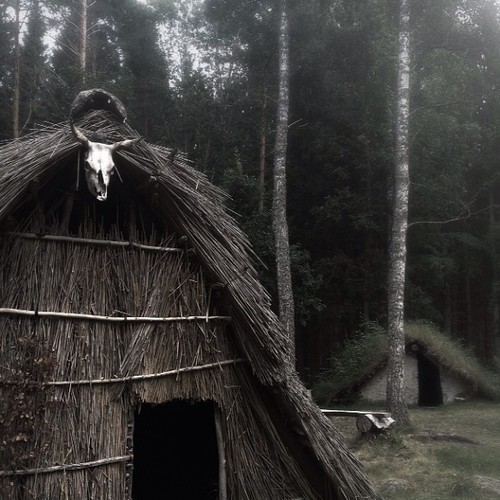
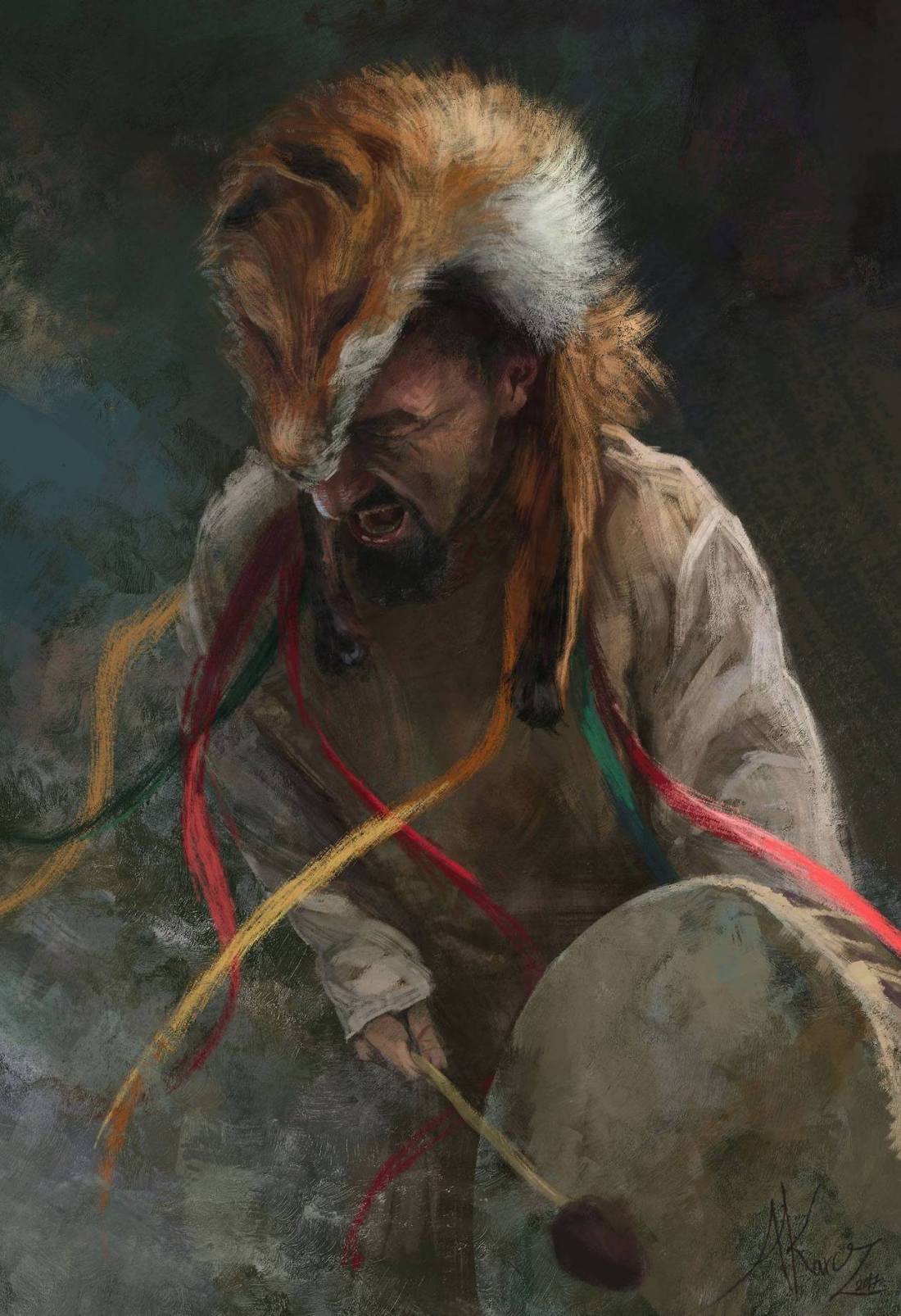
Wołchw is a Slavic shaman and seer/prophet dealing with the spiritual life and magick, and mediating with the god Weles (Veles). Wołchw is responsible for passing down the oral traditions of a community. Recitations, music, dance and often also natural intoxicants putting them into a trance are important in their rituals.
Another similar profession is a guślarz, strongly focused on the ‘shamanic’ aspects and on conducting various common rites (for example healing practices or charms). Guślarz is derived from a noun gusła that describes primarily the rites during which the souls are being summoned from the outerworld. He is the conductor of the annual rites of dziady when the souls of the ancestors are invited for a feast and paid homage.
Another important profession is that of a żerca, a priest and a spiritual leader. Żerca leads sacrificing practices, major divinations and important ceremonies like weddings, and is responsible for designating dates of the religious festivals. They protect the sacred sites (temples, groves, sacred fires). In the past they were seen as the most elite profession among those mentioned above, and held the most of political power – it was also usually them who advised the rulers. The word żerca is derived from a noun żertwa which means an offering.
(side note: the words wołchw, guślarz and żerca are shown in the Polish language above and they are spelled differently in the other Slavic languages in which they also exist)
One of the biggest steps of any mission starts right here on
Earth at a computer desk – NASA runs on software, period. Rovers can’t move,
spacecraft can’t fly, even rockets can’t blast off without the software codes
that run them all.
We’ve compiled hundreds of these powerful codes into
one location at software.nasa.gov. And guess what? You can start downloading
them right now for free! Here are just a few you can use:
TetrUSS has been used extensively for space launch vehicle
analysis and design, like on the Space Launch System, which is planned to take
humans to Mars.
You really could say it’s helping us to “blast off.” Outside
of NASA, this software has been used to analyze Mars planetary entry vehicles,
ballistics and even high-altitude sky diver aerodynamics. Basically if
anything has moved through any planetary atmosphere, this software has played a
role.
2. KNIFE (part of the FUN3D software and released as a package)
The name may be a bit intimidating, but with good reason –
KNIFE packs a powerful punch.
It was created to help us learn more about the
sonic booms that resonate when planes break the sound barrier, but it has also
helped develop green energy sources such as wind turbines and techniques to
minimize drag for long-haul trucking. Maybe we should re-name this versatile
and handy code, “Swiss Army KNIFE?”
3. Cart3D (Automated Triangle Geometry Processing for Surface Modeling and Cartesian Grid Generation)
If software codes went to high school, Cart3D would be Prom
Queen. This software is so popular, it is being used in almost every mission area here at NASA.
Engineers and scientists are currently using it to model
everything from advanced drones to quieter supersonic aircraft.
4. FACET (Future Air Traffic Management Concepts Evaluation Tool)
Frequent flyers: this may be your favorite code without even
knowing it. FACET was developed to evaluate futuristic concepts in air traffic
management, and it has served as a testbed for assessing today’s regular
operations.
To sum it up, this software code helps airports keep planes
organized in the air and on the ground.
5.GIPSY-OASIS
GIPSY-OASIS is part of the GPS system to end all GPS systems. It’s so accurate, John Deere used it to help create self-driving tractors.
How? John Deere already had a navigation system in the works, but it
could only be used in certain parts of the world.
Our ground stations are all
across the globe, and our software ensures accuracy down to a few inches. And
so, a new breed of tractor was born! Did
we mention this software is free?
These are just a few examples of the software NASA has
available for free public and consumer use. To browse the catalog online, check
out software.nasa.gov.









 kluskiwszechmocy