Let’s kick this off with some recent portfolio work! Hi all and welcome. I’ll be using this to post daily sketches and finished art work. Feel free to ask me anything you’d like and thanks for stopping by!
Friends, you have come to the right person. I may or may not have read a lot *cough* hundreds *cough* of these fics within a day…
Here are a few that I enjoyed! Hope you like them too!
Stripper AU
Applause by 98tuffluv, Explicit, 22k Victor Nikiforov is a four-time gold medalist in the GPF. In his fifth year going for gold, he travels to the United States, and meets Yuri Katsuki, a Japanese immigrant who works at a strip club to put himself through school and to support his family who are struggling to dig their roots into the new country. LOVE THIS FIC!
Yu-topia Gentleman’s Club by Aradellia (CurtusPatronus), Teen, 35k Victor hadn’t exactly wanted the end of his long training day to finish at the bottom of a glass alongside his friend Chris, however he hadn’t expected Chris to drag him to a strip club, of all places. Great stripper AU!
Thick Thighs Save Lives by doubtfulbones, Mature, 1.7k The banquet was just another way for Yuuri to let his hair down, and forget about the stress of the Short Program. The banquet also gives him a chance to drink. And seduce his coach. HOTTT
Yuuri!!! On Pole by Noble_Nook, Explicit, 31k Viktor Nikiforov is an accomplished, world famous dancer-turned-choreographer who has struck out to rekindle a spark he seems to be missing after so many years on and off the stage, only to soon find it wrapped around a stripper pole in Japan. Definitely recommend!
Eros is His Name by seekingslender, Mature, 32k (WIP) The hot spring has fallen on hard times financially, and Yuuri seeks out a part time job to help out. However, he finds enjoyment in something he’d never thought he’d do: erotic dancing at a club going under the stage name “Eros.” AMAZING FIC!
Sex on ice by aldinee, Explicit, 5.3k (WIP) Yuri needed the money. Yes, he might have been a pro-skater, but he was also a college student who spent too much money on clothes and skating related merchandise, especially the ones from his idol Victor Nikiforov. So, when he was offered to work at a Strip Club, he accepted. Thumbs up!
Eros!!! on Pole by sushicorps (Inclinant), Gen, 3.4k Katsuki Yuuri is a professional pole aerobics teacher. Professional, mind you. But good lord, will having to teach one Viktor Nikiforov be the absolute death of him. You know, if he can get the other to stop thinking he’s just the receptionist first. OMG SO GOOD AND FUNNY
Neon Pink by doubtfulbones, Explicit, 18k When Viktor finally has some alone time after skating and intense exercise, he likes to occupy himself with the bar downtown. With a pink, flickering sign and a promising interior, Eros was always his first choice, and most favourite. Highly recommend!
More by wisia, Mature 2.3k In which Christophe takes Victor to a strip club, and Victor gets more than expected. This is an awesome one shot, must read!
Bachelor Party by QuinnTuha608, Explicit, 1.2k Usually your future husband isn’t the stripper at your bachelor party. JUST READ THIS… you can thank me later..
My Heart Dances for You by BillCipherTriangle, Explicit, 3.5k (WIP) Katsuki Yuri is one of the world’s best Strippers. One fateful night, he meets Victor Nikiforov at a show. At first glance Victor is the most handsome club owner Yuri has ever met.
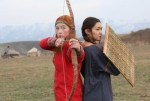
Kazakh filmmakers are making a trilogy of films about the Scythian/Saka warrior women of the ancient world. These historical reenactment movies focus on the women who in part inspired the Greek Amazon myths – the same women to whom former RPs Tirgatao and Tomyris are closely linked!
There’s very little English language information on the films so far, but the Women of Kazakhstan page on Facebook has translated an article found here (translation below): http://www.m.kazpravda.kz/news/view/97896/
Movie about women in Saka period has started in Almaty region of Kazakhstan.
Kazpravda.kz informs that the Amazons documentary about female conquerors from Saka-Scythian tribes is shot by Colibri films Kazakh production studio upon the request of Smithsonian channel USA, Urban canyons production company UK and ZDF channel Germany. Amazons project is the first part of the trilogy named Warrior women, which will consist of three series for 52 minutes each and tell the world about the most skillful and iconic female warriors that have existed since the V century BC to the present time. Thus, the theme will be disclosed on military achievements of the Amazons who lived on the territory of the Altai to the Black Sea, gladiatrix, which the Romans used for entertainment as well as the history of the African Women’s shelf Mino, noted in the war against the French colonial forces.
The film will be presented in the genre of historical reconstruction, also based on the staged shooting and computer graphics. In addition, the idea of directors includes interviews with historians, archaeologists and museum curators, with an exciting narrative, in which the sacrifice and perseverance has become a way of life of girls who fell in the bloody battle of their time.
The main customer of the documentary is the Smithsonian channel, American television channel that is a part of Smithsonian Scientific and Research Institute that is respected all over the world. The reliability and accuracy of the rankings of which is even ahead of the National Geographic Channel. After Kazakhstan shootings will continue in West Africa, France, the United States and UK.
First film of Amazons trilogy tells the story of three Amazons of the Eurasian steppes named Alkaya, Samsi and Aella, played by Gaziza-Tansholpan Tleubay (“Kazakh khanate”), Hulan Chuluun and Dinara Baktybaeva (“He and She”).
Online casting of actors was done by Colibri films studio, but the final choice yet remained on foreign producers who wanted to show the diversity and uniqueness of the appearance of representatives of Saka-Scythian tribes, and therefore chose three main facial features faces: Mongolian, Turkish and European. United Kingdom company that partners the film asked to invite Chuluun Hulan actress, who had remembered to the world for the femalrole in Sergei Bodrov’s “Mongol” movie. Now Chuluun and her husband Naryn Igilik – executive producer of Amazona and director of the Colibri films are expecting a baby the filmmakers rewrote the script especially for her where she will play a married woman with her real eldest daughter.
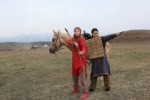
Team of Colibri films recreated unique costumes and weapons of 5 century BC. of Saka-Scythian period specially for this film. Shooting elements were reproduced on the basis of real objects found in ancient burial mounds of Saka. It is noteworthy that even Scythian conical folding structures that did exist and are considered the prototype of the Kazakh yurt were shown. The accuracy of all the details of the films are checked by consultants of the project professor Adrienne Mayor from Stanford University, author of the American best-seller the Amazons, as well as international and Kazakh historians and archaeologists.
“This film is about how and why Saki women were warriors on the example of a girl who lost her family and from an early age learned to hunt and fight. Saka Amazon is a strong, brave and sacrificing women, she easily could lead the tribe, use the armor and had the ability to negotiate. She was the guardian of the hearth and the beautiful muse at the same time”, – said the executive producer of the project Naryn Igilik.
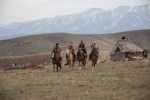
Filming of trilogy has began in June this year in Malta. The filmmakers started filming in Kazakhstan on October 18 in Almaty and Almaty region. The film was shot near the village Museum of Zhambyl of Zhambyl district of Almaty region. Small homeland of Naryn Igilik, which was demonsrated in Ermek Tursunov’s “Shal” movie upon his recommendation, immediately amazed the foreign producers with its diversity and pristine wilderness. Mountains of Zailiyskiy Alatau, hills and Zhailau perfectly suited the filming of Amazons.
Art director of the movie is Marat Sagit, costume director – Zauresh Zhabagina, makeup artist – Sergei Maurin (Ukraine).
“At first we wanted to order the project at “Kazakh film” JSC named after Shaken Aimanov, but because of the protracted bureaucratic delays in the negotiations and the deadline we had to change the mind and seek for independent private studio. So, we went to the director of Colibri films Naryn Igilik, that stands behind such famous films as “Mongol”, “Shal”, and is soon expected to release “Kazakh Khanate” movie. I am glad that the Naryn and stunt group “Nomad” invited by him fully met our expectations. They could qualitatively shot realistic scenes even with not so big television budget “, – Peter Sebastian producer of the Urban canyons production company from UK.
The world premiere will take place in October 2017 on Smithsonian channel, and the trilogy will be broadcasted on following channels Viasat history, the German ZDF, Scandinavian MTG and many TV channels in the UK.
But the pecularity of this global project is that the producer Naryn Igilik already agreed with foreign partners that his studio Colibri films won the right to represent and sell this film in Kazakhstan. Therefore, as an exception the first premiere of this global trilogy on Amazons will be held in our country. Igilik dreams to present this documentary about the ancient history to the millions of foreign visitors in frames of “EXPO-2017” exhibition.
"This is my first experience in the documentary historical filming and I was very struck by the story, costumes, weapons and, above all, the image of our foremothers. In those days, it turns out, the feminism was quite vibrant. There was even a scene where my character chose a man for herself. It was funny! It’s too bas there was not enough time for preparations works, that is why I was replaced in the archery and horse racing scenes. When I had free time, I often tried to ride, and all this, together with the surrounding environment, affected my future decision to try myself in “Nomad” group and possibly start filming in the historical genre, “- said the actress Dinara Baktybaeva.
All this time. ALL THIS TIME i had no idea SAI had perspective transform capabilities.
What?????????????? Is this?????????? How do ???????
I think they mean the Free Transform selection! If you use that correctly you can mess with the selected objects form a bit better?
oh thank you! i noticed with transform selection that using CTRL gives it different effects, i just didnt know what all what this was and thought there was some funnky feature i never knew about
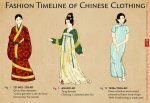
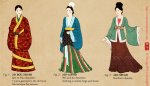
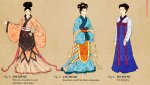
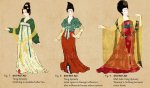
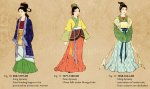
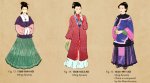
Chinese clothing has approximately 5,000 years of history behind it, but regrettably I am only able to cover 2,500 years in this fashion timeline. I began with the Han dynasty as the term <i>hanfu</i> (Chinese clothing) was coined in that period. Please bear in mind that this is only a generalized timeline of Chinese clothing primarily featuring aristocratic and upper-class ethnic Han Chinese women (the exceptions are Fig. 8 (dancer) and Fig. 11 (maid, due to the fact I couldn’t find many paintings in this period)).
My resources are mainly the books: 5,000 years of Chinese Costume, China Chic: East Meets West, and Changing Clothes in China: Fashion, History, Nation. 5,000 years of Chinese Costume is an invaluable resource (though sadly currently out of print), I would highly recommend this book if you can get your hands on it.
Han Dynasty:
“In the Han Dynasty, as of old, the one-piece garment remained the formal dress for women. However, it was somewhat different from that of the Warring States Period, in that it had an increased number of curves in the front and broadened lower hems. Close-fitting at the waist, it was always tied with a silk girdle.” (5,000 years of Chinese Costume, pg. 32)
Wei and Jin dynasties:
“On the whole, the costumes of the Wei and Jin period still followed the patterns of Qin and Han.” (5,000 years of Chinese Costume, pg. 54)
“From the costumes worn by the benefactors in the Dunhuang murals and the costumes of the pottery figurines unearthed in Louyang, it can be seen that women’s costumes in the period of Wei and Jin were generally large and loose. The upper garment opened at the front and was tied at the waist. The sleeves were broad and fringed at the cuffs with decorative borders of a different colour. The skirt had spaced coloured stripes and was tied with a white silk band at the waist. There was also an apron between the upper garment and skirt for the purpose of fastening the waist. Apart from wearing a multi-coloured skirt, women also wore other kinds such as the crimson gauze-covered skirt, the red-blue striped gauze double skirt, and the barrel-shaped red gauze skirt. Many of these styles are mentioned inhistorical records.” (5,000 years of Chinese Costume, pg. 65)
Southern and Northern Dynasties:
“During the Wei, Jin and the Southern and Northern Dynasties, though men no longer wore the traditional one-piece garment, some women continued to do so. However, the style was quite different from that seen in the Han Dynasty. Typically the women’s dress was decorated with xian and shao. The latter refers to pieces of silk cloth sewn onto the lower hem of the dress, which were wide at the top and narrow at the bottom, so that triangles were formed overlapping each other. Xian refers to some relatively long ribbons which extended from the short-cut skirt. While the wearer was walking, these lengthy ribbons made the sharp corners n the lower hem wave like a flying swallow, hence the Chinese phrase ‘beautiful ribbons and flying swallowtail’.” (5,000 years of Chinese Costume, pg. 62)
“During the Southern and Northern Dynasties, costumes underwent further changes in style. The long flying ribbons were no longer seen and the swallowtailed corners became enlarged. As a result the flying ribbons and swallowtailed corners were combined into one.” (5,000 years of Chinese Costume, pg. 62)
Sui Dynasty:
“During the period of the Sui and early Tang, a short jacket with tight sleeves was worn in conjunction with a tight long skirt whose waist was fastened almost to the armpits with a silk ribbon. In the ensuing century, the style of this costume remained basically the same, except for some minor changes such as letting out the jacket and/or its sleeves.” (5,000 years of Chinese Costume, pg. 88)
Tang Dynasty:
“The Tang Dynasty was the most prosperous period in China’s feudal society. Changan (now Xian, Shananxi Province), the capital, was the political, economic and cultural centre of the nation. […] Residents in Changan included people of such nationalities as Huihe (Uygur,) Tubo (Tibetan), and Nanzhao (Yi), and even Japanese, Xinluo (Korean), Persian and Arabian. Meanwhile, people frequently travelled to and fro between countries like Vietnam, India and the East Roman Empire and Changan, thus spreading Chinese culture to other parts of the world.” (5,000 years of Chinese Costume, pg. 76)
“…all the national minorities and foreign envoys who thronged the streets of Changan also contributed something of their own culture to the Tang. Consequently, paintings, carvings, music and dances of the Tang absorbed something of foreign skills and styles. The Tang government adopted the policy of taking in every exotic form whether or hats or clothing, so that Tang costumes became increasingly picturesque and beautiful.” (5,000 years of Chinese Costume, pg. 88)
“Women of the Tang Dynasty paid particular attention to facial appearance, and the application of powder or even rouge was common practice. Some women’s foreheads were painted dark yellow and the dai (a kind of dark blue pigment) was used to paint their eyebrows into different shapes that were called dai mei (painted eyebrows) in general.” (5,000 years of Chinese Costume, pg. 89)
“In the years of Tianbao during Emperor Xuanzong’s reign, women used to wear men’s costumes. This was not only a fashion among commoners, but also for a time it spread to the imperial court and became customary for women of high birth.” (5,000 years of Chinese Costume, pg. 89)
Song Dynasty
“The hairstyle of the women of the Song Dynasty still followed the fashion of the later period of the Tang Dynasty, the high bun being the favoured style. Women’s buns were often more than a foot in height.” (5,000 years of Chinese Costume, pg. 107)
“Women’s upper garments consisted mainly of coat, blouse, loose-sleeved dress, over-dress, short-sleeved jacket and vest. The lower garment was mostly a skirt.” (5,000 years of Chinese Costume, pg. 107)
“Women in the Song Dynasty seldom wore boots, since binding the feet had become fashionable.” (5,000 years of Chinese Costume, pg. 107)
“Although historians do not know exactly how or why foot binding began, it was apparently initially associated with dancers at the imperial court and professional female entertainers in the capital. During the Song dynasty (960-1279) the practice spread from the palace and entertainment quarters into the homes of the elite. ‘By the thirteenth century, archeological evidence shows clearly that foot-binding was practiced among the daughters and wives of officials,’ reports Patricia Buckley Ebrey […] Over the course of the next few centuries foot binding became increasingly common among gentry families, and the practice eventually penetrated the mass of the Chinese people.” (Chinese Chic: East Meets West, pg. 37-38)
Yuan Dynasty:
“Han women continued to wear the jacket and skirt. However, the choice of darker shades and buttoning on the left showed Mongolian influence.” (5,000 years of Chinese Costume, pg. 131)
“After the Mongols settled down in the Central Plains, Mongolian customs and costumes also had their influence on those of the Han people. While remaining the main costume for Han women, the jacket and skirt had deviated greatly in style from those of the Tang and Song periods. Tight-fitting garments gave way to big, loose ones; and collar, sleeves and skirt became straight. In addition, lighter more serene colours gained preference.” (5,000 years of Chinese Costume, pg. 142)
Ming Dynasty:
“The clothing for women in the Ming Dynasty consisted mainly of gowns, coats, rosy capes, over-dresses with or without sleeves, and skirts. These styles were imitations of ones first seen in the Tang and Song Dynasties. However, the openings were on the right-hand side, according to the Han Dynasty convention.” ((5,000 years of Chinese Costume, pg. 147)
“The formal dress for commoners could only be made of coarse purple cloth, and no gold embroidery was allowed. Gowns could only in such light colours as purple, green and pink; and in no case should crimson, reddish blue or yellow be used. These regulations were observed for over a decade, and it was not until the 14th year of Hong Wu that minor changes were made.” (5,000 years of Chinese Costume, pg. 147)
Qing Dynasty
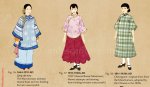
When China fell under Manchurian rule, Chinese men were forced to adopt Manchurian customs. As a sign of submission, the new government made a decree that men must shave their head and wear the Manchurian queue or lose their heads. Many choose the latter.
On the other hand, Chinese women were not pressured to adopt Manchurian clothing and fashions. “Women, in general, wore skirts as their lower garments, and red skirts were for women of position. At first, there were still the “phoenix-tail” skirt and the “moonlight” skirt and others from the Ming tradition. However the styles evolved with the passage of time: some skirts were adorned with ribbons that floated in the air when one walked; some had little bells fastened under them: others had their lower edge embroidered with wavy designs. As the dynasty drew to an end, the wearing of trousers became the fashion among commoner women. There were trousers with full crotches and over trousers, both made of silk embroidered with patters.” (5,000 years of Chinese Costume, pg. 173)
The Manchurians attempted several times to eradicate the practice of foot-binding, but were largely unsuccessful. Manchurian women admired the gait of bound women but were effectively banned from practicing food-binding. Hence, a “flower pot shoe” later came into creation and it allowed its wearer the same unsteady gait but without any need for foot-binding.
Republic Era
Women traditionally bound their breasts in the Ming and Qing dynasties with tight fitting vests and continued to do so in the early 20th century.
“The vests were called xiaomajia ‘little vest’ or xiaoshan ‘little shirt” “used by Chinese women as underclothing for the upper part of the body.” (Changing Clothes in China: Fashion, History, Nation: Finnane pg 162) “Doudu [is] a sort of apron for the upper body […] in former times the doudu had been worn by everyone, old and young, male and female. The young wore red, the middle-aged wore white or grey-green, the elderly wore black. A little pocket sewn into the top was used by adults to secrete them money and by children their sweets. When a girl got engaged, she would show off her embroidery skills by sending an elaborately worked doudu to her fiancé, decorated with bats for good forturne and pomegranates, symbolizing many sons.” (Changing Clothes in China: Fashion, History, Nation: Finnane pg 162)
A ban on bound breasts began in 1927, in which the government started advocating for the “Natural Breast Movement”. Despite this, bound breasts still widely continued into the 1930s. The government also banned earrings as it fell under the criteria of deforming the natural body. The 1930s also saw the introduction of the western/French bra come to Shanghai.
“The little vest was designed to constrain the breasts and streamline the body. Such a garment was necessary to look comme il faut around 1908, when (as J. Dyer Ball observed): ‘fashion decreed that jackets should fit tight, though not yielding to the contours of the figure, except in the slightest degree, as such an exposure of the body would be considered immodest.’ It became necessary again in the mid-twenties, when the jacket-blouse—a garment cut on rounded lines – began to give way to the qipao. At this stage, darts were not used to tailor the bodice or upper part of the qipao, nor would they be till the mid-fifties. The most that could be done by way of further fitting the qipao to the bosom was to stretch the material at the right places through ironing. Under these circumstances, breast-binding must have made the tailor’s task easier.” (Finnane 163, Changing Clothes in China: Fashion, History, Nation)
Successful eradication of bound feet would not come until the 1949 when the People’s Republic of China came into power.
1950s-1960’s
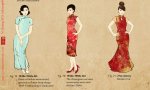
Under the People’s Republic of China, very few mainland women wore the cheongsam, save for ceremonial attire. Clothing became de-sexualized for mainlanders.
It was the flip side in Hong Kong, as the cheongsam continued its function as everyday wear which lasted until the late 1960s. The cheongsam in the 1950s and 1960s became even tighter fitting to further accentuate feminine curves. Western clothing became the default after the late 1960s, though the cheongsam continued to survive as uniforms for students (who donned a looser and androgynous version), waitresses, brides, and beauty contestants.
21st century
Designers today are creating new forms of the qipao/cheongsam. The mermaid tail appears to be a current popular trend.













 kluskiwszechmocy