Aww, thanks, anon. I’m pretty haphazard with things, but I’ll try to help.
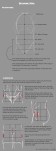
This is your new best friend!!
The friendly neighborhood scribbly circle here is your foundation for drawing heads from any angle.
Like, any angle.
Because even when viewed in perspective, the head still has the same amount of volume.
As for actually constructing a face and placement of features, you can see that when jotting down a face, I generally lay down those guidelines [here in green] so I have something to work off of when I’m expanding upon a sketch. I would mostly recommend being aware of the underlying structure of the face.
If you’re going for super-anatomically-correct, you can see that facial features line up in specific, symmetrical ways. For real though, nobody’s symmetrical and sometimes noses are long or ears are small and faces are asymmetrical or just plain different. So this is a foundation but not a cast iron rule.
I will say that the more you do it, the easier it will become! It all just takes practice. And I totally tried to screen record a sketch, but my computer is being hella slow and it keeps freezing up, so I give up. In lieu of something new, here’s an older process gif that I think shows things pretty well:
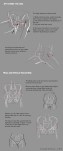
Poor neglected hips, such an awesome part of the body but so difficult to do *right*. It really just takes a few plotted landmarks and they’ll draw themselves, promise.
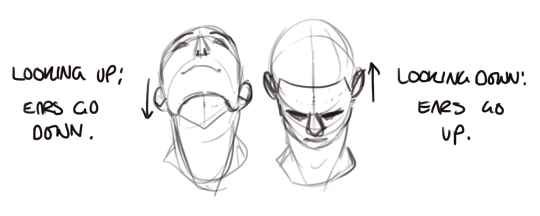
little art tip: the position of the ears on a human does a lot to communicate the angle of the head—whether it’s tilted forward or back.
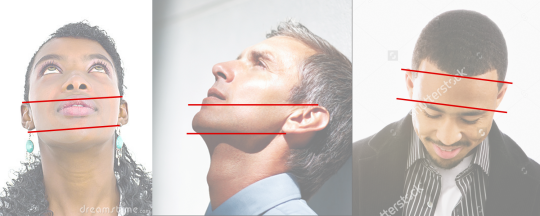
tilted back with the chin forward, the ears are going to look lower down, closer to the mouth; tilted forward with the chin tucked, the ears look higher up & more in line with the eyes.
Sorry I’m not hijacking, but this is a really good tip if people don’t know this. Like it does look really strange at first, but it is more realistic than drawing them in the centre of the side plane of the head. So it looks like this;;;









 kluskiwszechmocy